The Old Friend Returns: How Aboriginal Rangers Are Healing Country with Fire
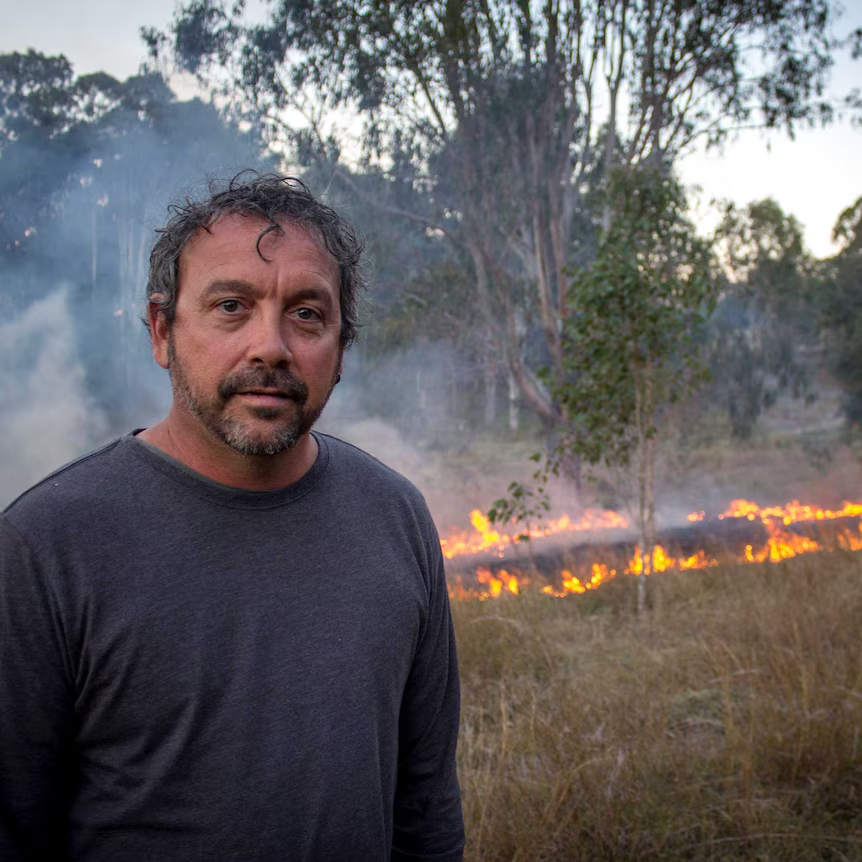
The morning air in Cape York is cool, but Victor Steffensen can already smell the country changing. He kneels on the red dirt, his fingers parting a patch of native sorghum grass. To an untrained eye, this looks like a pristine, wild corner of northern Australia. To Steffensen, a Tagalaka man, the land is suffocating, choked with dead thatch from previous seasons.
“The land is sick,” Steffensen says softly. “It’s been neglected for too long. It’s scared of the fire because it only knows the bad kind now.”
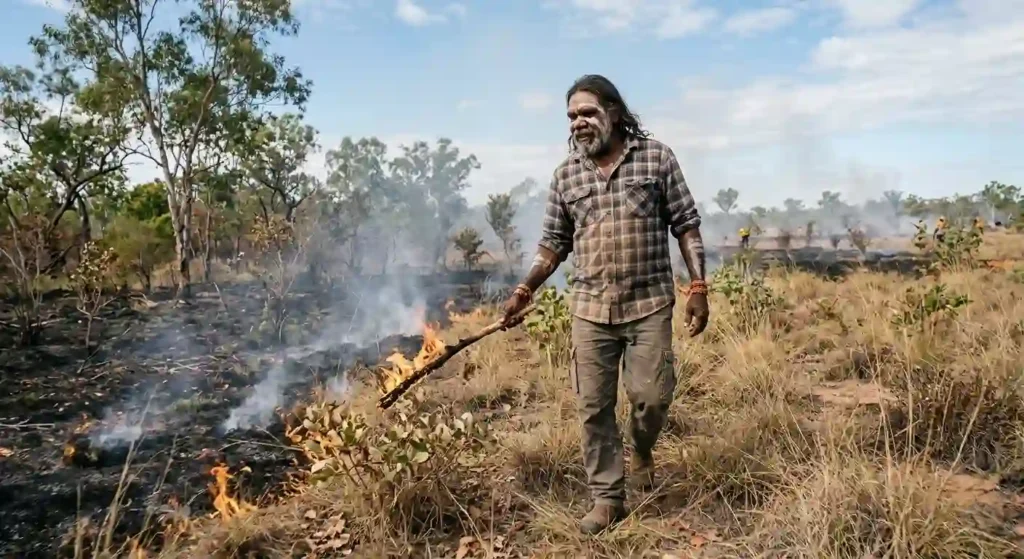
He strikes a single match. Instead of starting a roaring blaze, he coaxes a tiny flame onto a single tussock of dry grass, watching the morning breeze. Within minutes, a low ribbon of white smoke weaves through the eucalyptus trees. Moving no faster than a walking pace, the fire trickles across the ground like water, consuming dead fuel while leaving green shoots untouched. Insects hop out of its path; birds swoop down to catch grasshoppers in the smoke.
This is not a wildfire. This is right-way fire. For Steffensen and Indigenous communities across Australia, this flame is an old friend returning home—and it represents the oldest continuous land-management practice on Earth.
The Ecology of Disruption
For over 60,000 years, First Nations people practiced “cultural burning” or “cool burning.” Practitioners read the wind, humidity, insect life cycles, and the flowering patterns of trees to determine exactly when and how much to burn.
When colonisation disrupted these ancient cycles, removing Indigenous people from their homelands, the balance of the continent shattered. The new settlers viewed fire exclusively as an enemy to be suppressed. For more than two centuries, the dominant approach was simple: put out every fire as quickly as possible.
But nature does not adapt well to total suppression in a fire-prone landscape. Without regular, low-intensity cool burns, the bush grew dense. Overgrown shrubs formed ladders connecting the forest floor to the canopy, transforming the landscape into an ecological time bomb.
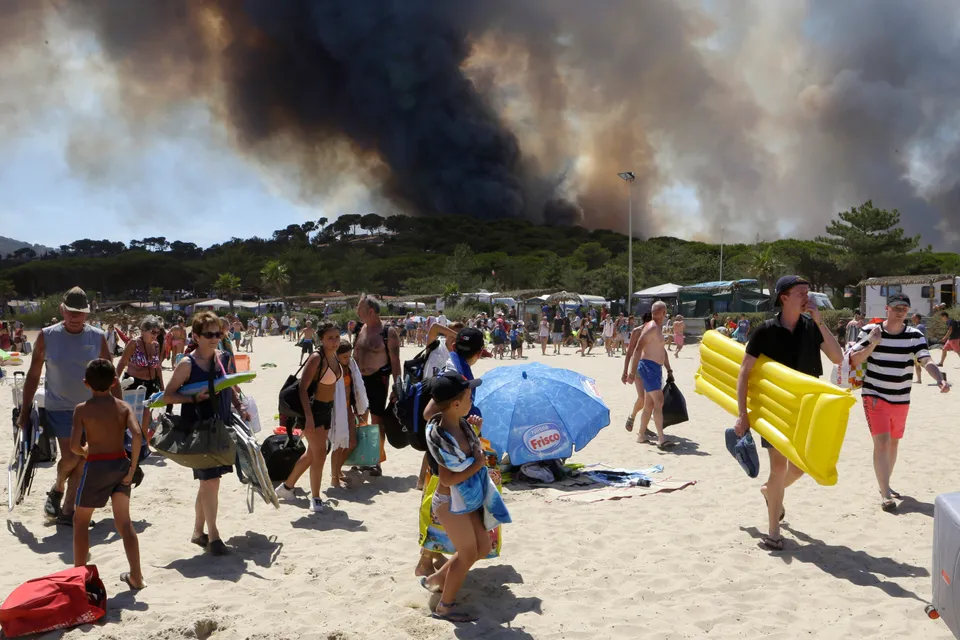
The catastrophic “Black Summer” bushfires of 2019 and 2020 were the tragic climax of this historical neglect. Fuelled by climate change and drought, mega-fires tore through more than 24 million hectares of land. These fires burned so hot they created their own weather systems, destroyed ancient rainforests, and killed or displaced an estimated three billion animals. It was a devastating realization: the modern strategy was failing.
Reading the Country: The Science of Cool Burning
To understand why traditional burning works, one must look at the profound ecological differences between a modern wildfire and an Indigenous cultural burn.
Wildfires typically strike during the height of summer, driven by scorching winds and immense fuel loads. They burn with terrifying intensity, often exceeding 1,000°C, consuming soil microbiology, buried seeds, and the ancient canopy trees where wildlife seeks refuge.
A cultural burn, by contrast, takes place early in the dry season when the ground still holds moisture from the monsoon rains. The fires are lit in the cool of the morning or late evening.
- Temperature Control: These fires rarely rise above knee-height, allowing people to stand just a few feet away without feeling overwhelming heat.
- The Canopy Shield: The flames burn so low that the forest canopy remains completely untouched, preserving shade and retaining soil moisture.
- Creating a Mosaic: Because these burns are done in small patches, they create a protective “mosaic” across the landscape—a patchwork quilt of freshly burnt, regenerating, and unburnt ground.
When a summer wildfire inevitably sparks, it hits these previously burnt patches and starves of fuel, losing its destructive momentum. Recent research confirms that traditional burning can halve shrub cover, dramatically reducing mega-fire risks while doubling regional biodiversity.
Healing the Spirit: The Banbai and Martu Rangers
Across the continent, this revival is being led by Indigenous Ranger programs, turning environmental science into a deeply human story of cultural reclamation.
In the rugged tablelands of New South Wales, the Banbai Rangers combine ancient knowledge with modern science to protect their ancestral lands at Wattleridge. For the Banbai people, fire is intimately woven into language, stories, and ceremonies. By returning the fire-stick, they are reviving an ecosystem that supports culturally significant species like the endangered spotted-tailed quoll.
Thousands of kilometers away in the Western Desert, the Martu Rangers work alongside elders like Kirriwirri to restore the desert landscape. To an outsider, the vast spinifex plains look desolate after a fire. But the Martu see an immediate rebirth.
Elders point out how the charred ground quickly springs back with life-sustaining bush foods—like wild potato and bush tomato—which cannot grow under the suffocating canopy of overgrown spinifex. The mosaic of vegetation provides vital habitat for small mammals like the marl (rufus hare-wallaby), which rely on fresh growth for food and older, unburnt patches for shelter from predators.
For older generations, seeing smoke rise in the right season brings a profound sense of relief. Elders recall how the land felt “empty” and silent when the traditional fires stopped decades ago. As younger rangers carry the flame back into the bush, that deep sense of belonging and cultural pride is flooding back.
A New Economy Built on Custodianship
The return of cultural burning is also driving a major socio-economic shift through savanna burning carbon projects. Under government carbon farming initiatives, traditional owners are paid to conduct strategic, early-dry-season burns. By burning early when fires are cool, rangers prevent the massive, high-emission wildfires that would otherwise ravage the savanna later in the year.
This elegant shift has created a multi-million-dollar carbon credit economy. Remote communities are funding their own ranger positions, investing in schools, and building infrastructure, allowing Indigenous people to thrive through stewardship rather than extractive industries.
Furthermore, it has forced an evolution in how Western fire authorities operate. State emergency services now regularly collaborate with Indigenous fire experts to plan regional disaster mitigation. The old paradigm of excluding humans from nature to “protect” it is giving way to a holistic understanding: the Australian landscape stays healthy precisely because people are in it, listening to it, and actively caring for it.
Lessons from the Smoke
As the global climate warms and fire seasons grow more dangerous worldwide, the lessons of Australia’s Aboriginal rangers carry global resonance. They remind us that true conservation cannot be outsourced entirely to satellite data or rigid bureaucratic rules. It must be felt underfoot and carried in the heart.
Back in Cape York, Victor Steffensen watches the last of his morning fire fizzle out against a rocky creek bed, exactly where he knew it would stop. The ground is clean, covered in a light layer of black ash that will act as fertilizer when the next rain falls. The canopy above remains green, vibrant, and alive.
“We need to change our relationship with fire,” Steffensen says, wiping a streak of charcoal from his hand. “If you look at fire with fear, you will never understand it. But if you look at it as a way to give back to the earth, to clean it and refresh it, it becomes something beautiful.”
In the heart of the Australian bush, the smoke rising into the sky is no longer a signal of impending disaster. Thanks to the traditional custodians who know the land best, it is a sign that the country is finally breathing again.