The Phoenix of the Maas: How Rotterdam Turned Ruin into an Architectural Playground
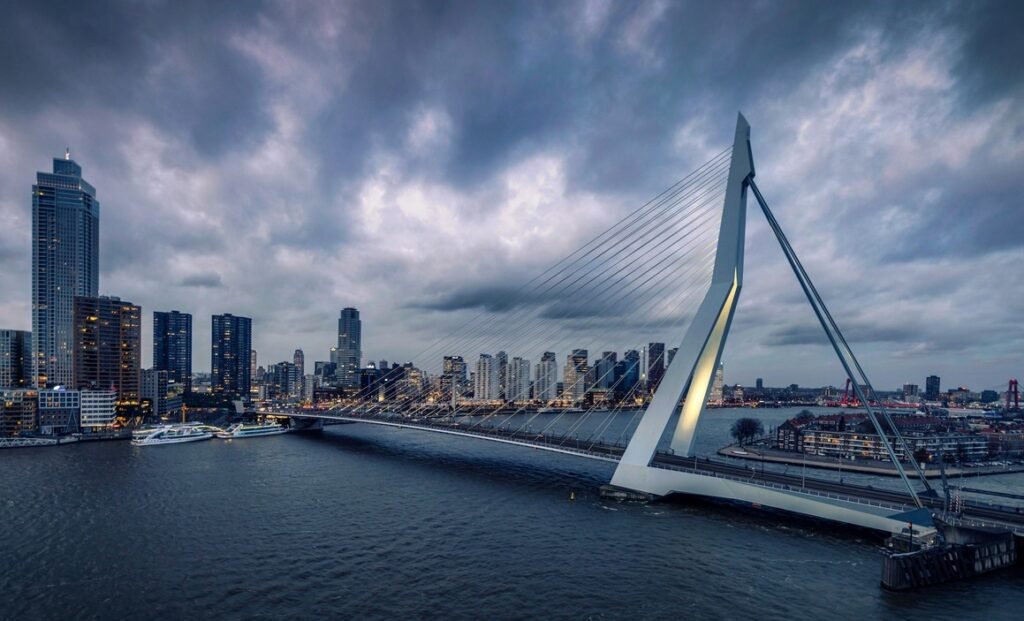
To walk through the center of a typical Dutch city is to step into a Golden Age watercolor—a tapestry of brick gables, cobbled streets, and narrow medieval canals. To walk through Rotterdam, however, is to step into a vision of the future. Towering skyscrapers of glass and steel rise beside gravity-defying architecture, wide boulevards, and bold urban experiments. Rotterdam is a striking anomaly in the Netherlands. Its modern identity was not shaped by centuries of gradual change, but forged in the aftermath of a catastrophe that forever transformed the city.
Old Rotterdam: The Lost Maritime Maze
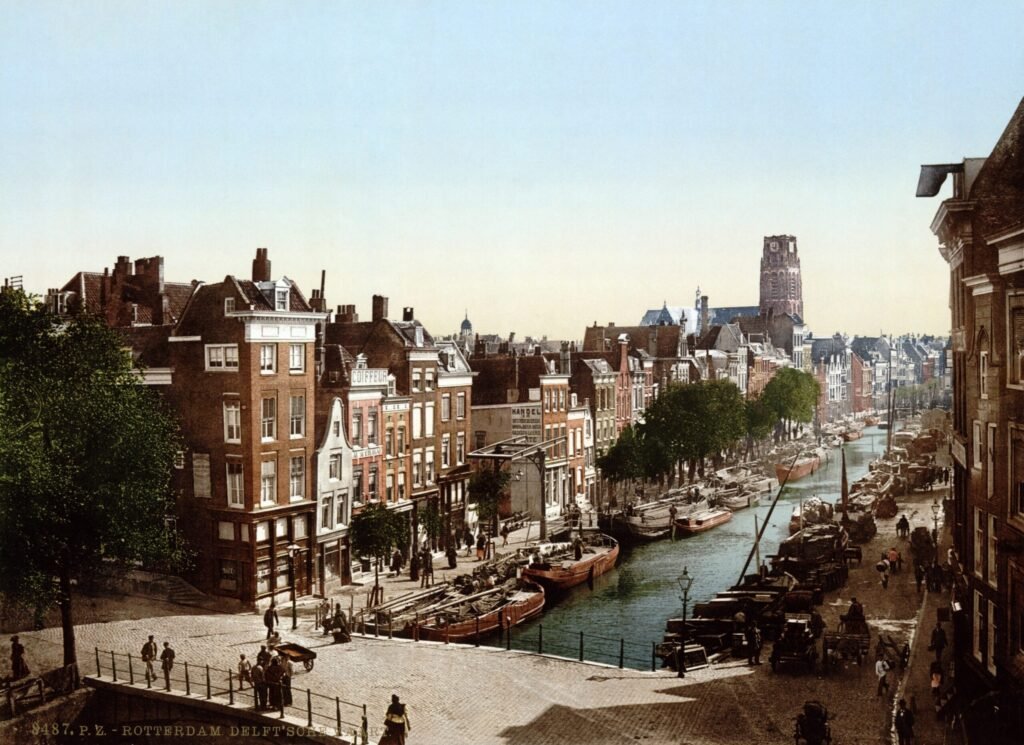
Before May 1940, Rotterdam was a quintessential historical Dutch city. Its heart was a labyrinth of centuries-old alleyways, bustling markets, and grand merchant homes dating back to the Middle Ages. What set it apart, however, was how deeply the city breathed the salty air of the North Sea.
Unlike Amsterdam, where canals functioned largely as urban roads, Rotterdam’s inner-city canals were deep-water harbor basins. Large ocean-going ships glided past backdoors and warehouses right in the middle of town, establishing the city as a thriving, chaotic, and romantic global trading hub.
May 14, 1940: The Day the History Evaporated
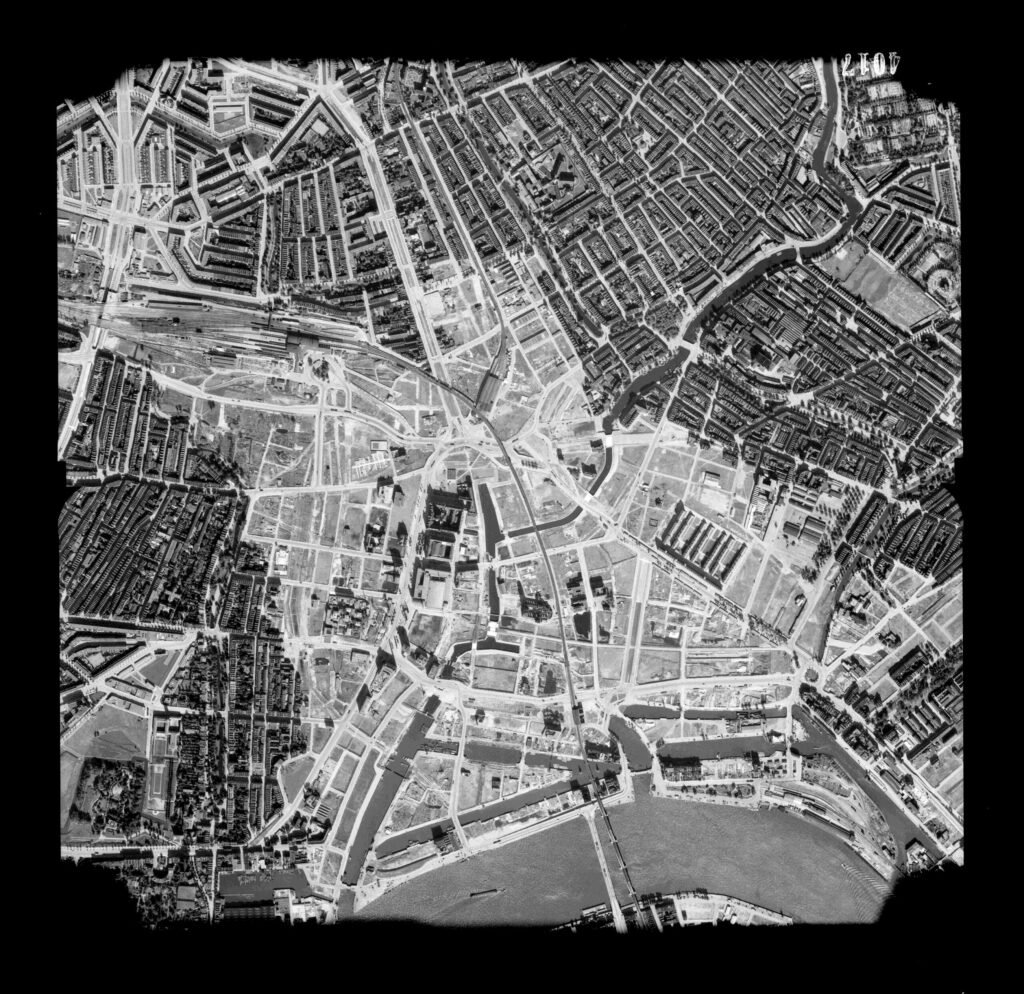
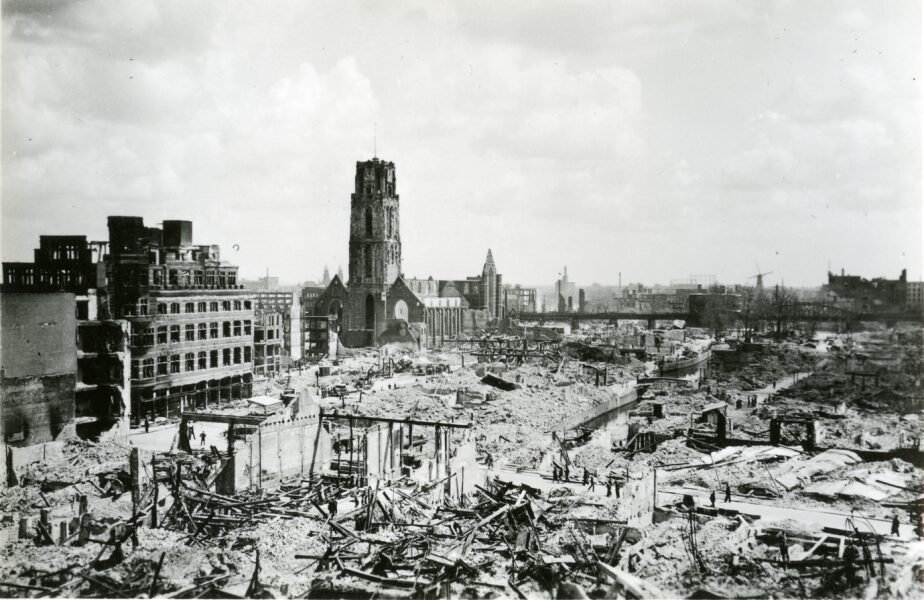
The trajectory of the city changed forever during the opening days of World War II. On May 14, 1940, following the German invasion, a terrifying aerial bombardment—the Rotterdam Blitz—was unleashed by the Luftwaffe to force a swift Dutch surrender.
In a matter of fifteen minutes, German bombers systematically dropped tons of high-explosives and incendiary devices across the city’s dense core. The resulting firestorm burned uncontrollably for days.
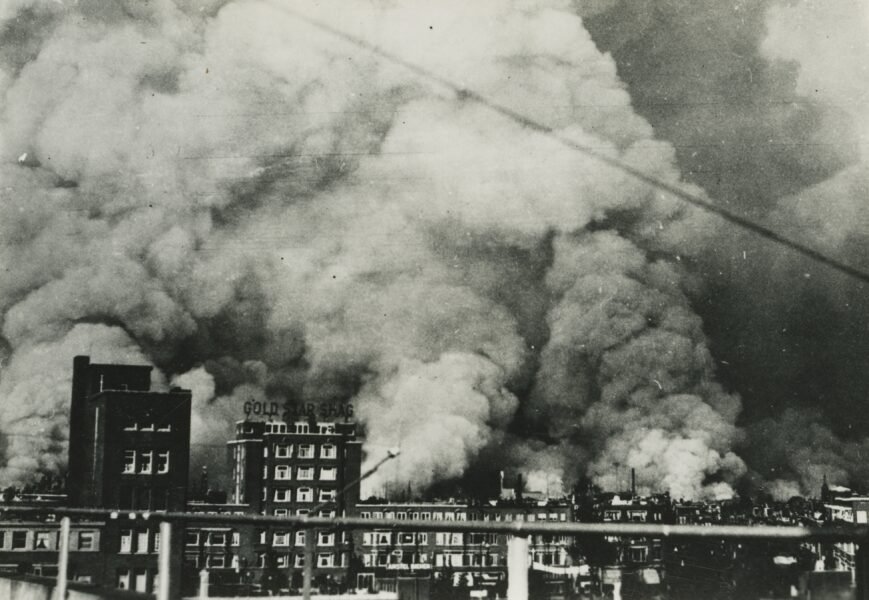
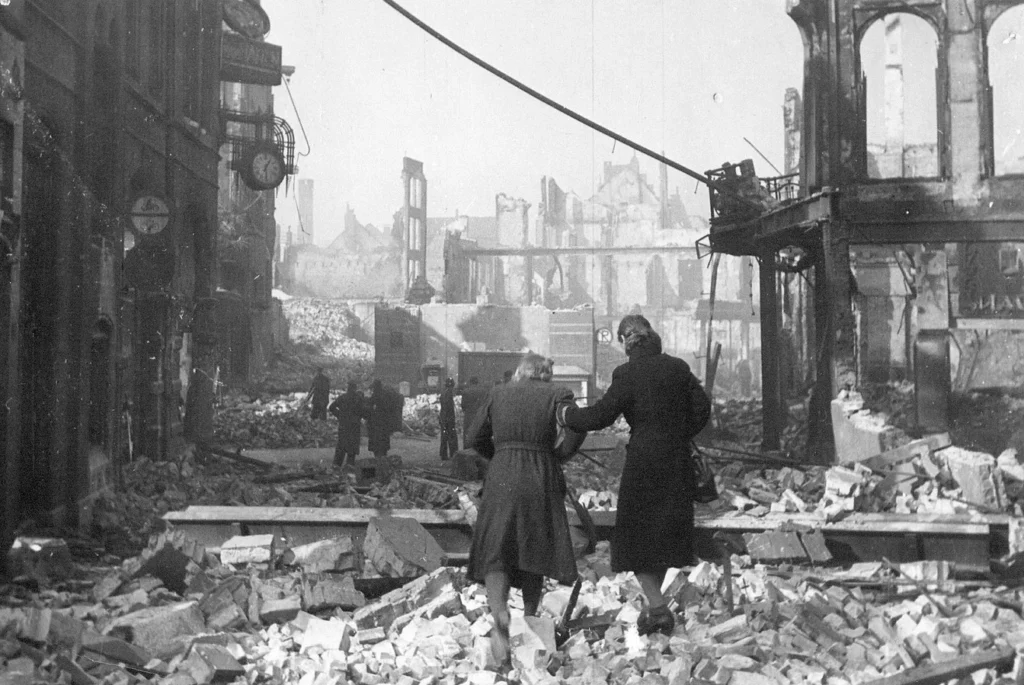
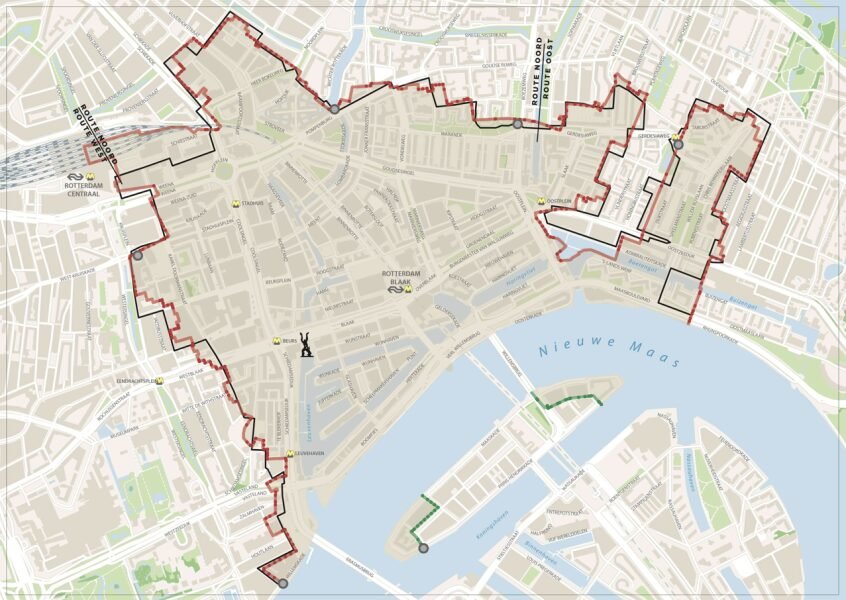
The attack obliterated roughly one square mile (about 2.6 square kilometers) of the city center. Gone were 31 department stores, 24 churches, dozens of schools, and centuries of architectural heritage. When the smoke finally cleared, the historic heart of Rotterdam was a flat wasteland of smoldering ash.
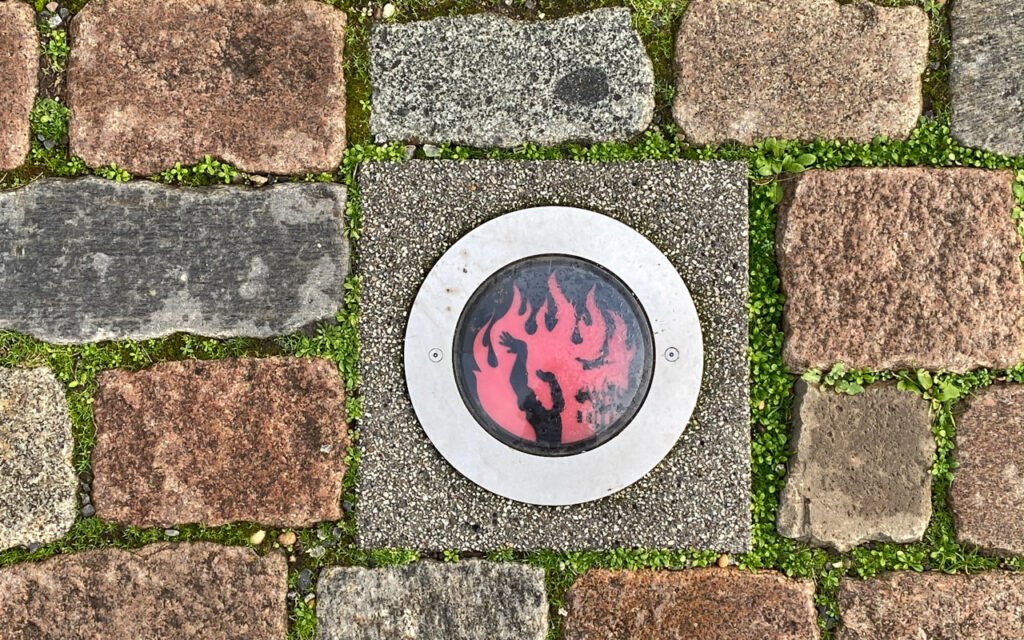
Today, this specific perimeter of devastation is physically etched into the city’s modern streets. Known as the Brandgrens (fire boundary), it is marked by a continuous line of glowing, red-lit icons embedded directly into the pavement. Walking over these markers means crossing the exact border where the terrifying firestorm finally halted, separating the few historic structures that survived from the modern world built from the ashes.
The Tabula Rasa Choice: A Completely New Vision
While the debris was still warm, the city had to make a monumental choice. The initial proposal by city architect Willem Gerrit Witteveen aimed to restore the traditional street layout while widening roads for modern traffic. However, in 1944, a more radical vision emerged under Cornelis van Traa: The Basic Plan (Basisplan).
Instead of looking backward and meticulously rebuilding the medieval core from the rubble, Rotterdam’s leaders chose a tabula rasa—a clean slate. They decided to build a completely new, modern metropolis.
They did this partly out of sheer pragmatism: the old city was plagued by severe traffic congestion and overcrowding. But it was also a philosophical statement. The planners embraced the modernist principles of the CIAM (International Congresses of Modern Architecture), which prioritized light, air, space, and a strict separation of urban functions: living, working, and recreation.
The Trade-Offs of the New Plan
The Pros: The open grid plan successfully transformed Rotterdam into a functional, car-friendly economic engine. It birthed the Lijnbaan (1953), the world’s first purposefully designed pedestrian-only shopping street, which became a global model for urban planning.
The Cons: By separating functions and moving residential housing to the outskirts, the new city center initially felt cold, sterile, and windswept. By the late 1960s and 1970s, critics complained that the center lacked soul, warmth, and human scale during evening hours when office workers went home.
Dialogue Between Old and New: The Architectural Playground
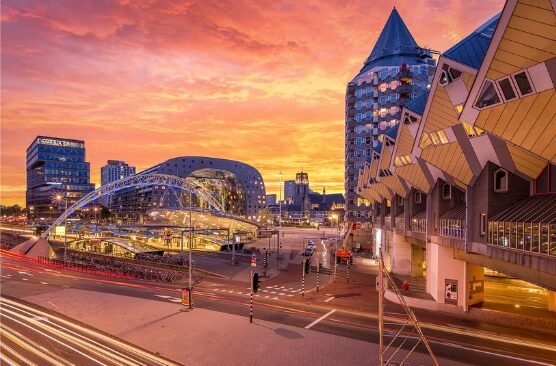
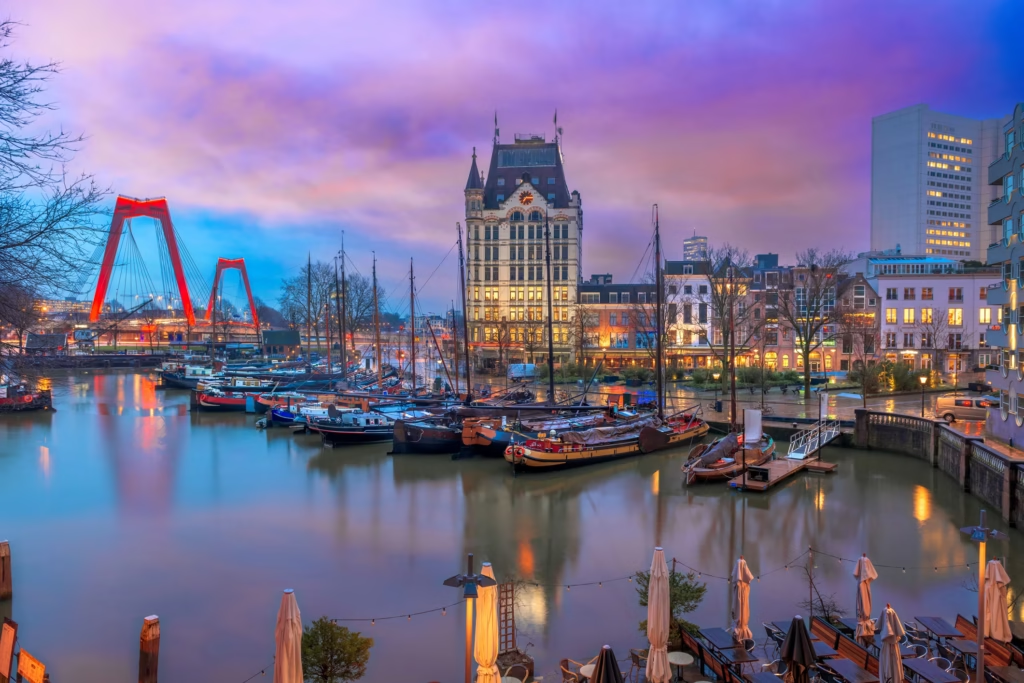
This early criticism sparked a second wave of innovative architecture in the late 1970s and 80s, intentionally shifting Rotterdam from a merely functional city to an experimental design laboratory. Today, the skyline is a fascinating conversation between the few resilient survivors of the Blitz and these modern triumphs.
The Survivors
- The Laurenskerk: The lone medieval survivor. Its heavily charred, hollow shell was saved from post-war demolition by passionate citizens, and it was lovingly restored as a symbol of Rotterdam’s endurance.
- The Witte Huis (White House): Built in 1898, this striking Art Nouveau building was once Europe’s tallest skyscraper at 43 meters high. It miraculously escaped the flames entirely.
- City Hall (Stadhuis): A grand, symmetrical Beaux-Arts structure completed in 1920, it survived with its heavily ornamented facade intact.
The Modern Icons
- The Cube Houses (Blaakse Bos): Designed by Piet Blom in the 1980s, these bright yellow, geometric houses are tilted at 45 degrees on hexagonal pylons, turning conventional concepts of living space completely on their head.
- The Markthal (Market Hall): A massive, horseshoe-shaped residential arch spanning a vibrant public market square. The interior ceiling features a digital, colossal artwork titled the Cornucopia, often called the “Sistine Chapel of Rotterdam.”
- De Rotterdam: A “vertical city” designed by Rem Koolhaas (OMA), composed of three interconnected, slightly displaced glass towers that shift configuration depending on the angle from which they are viewed.
The Port: From City Heart to Global Titan
The narrative of Rotterdam’s resilience is incomplete without its port. Before the war, the docks were woven tightly into the urban fabric. The bombing destroyed nearly half of the inner-city port infrastructure, paralyzing the local economy.
During the reconstruction, planners realized that massive post-war container ships could no longer navigate narrow inner-city channels. They made a strategic pivot: they closed the ruined historical basins to commercial traffic and pushed the port continuously westward toward the North Sea.
This expansion birthed the industrial giants of Europoort and the Maasvlakte, massive deep-water artificial peninsulas. The move allowed the Port of Rotterdam to become the largest port in the world for decades (and still the largest in Europe), while the old abandoned inner-city docks—like the Oude Haven—were transformed into lively, scenic waterfront terraces and creative hubs.
A Testament to Hope
Rotterdam stands as a poignant reminder that architecture is far more than concrete, glass, and steel; it is a manifestation of human will. The city chose to accept its scars, using them not as an anchor to historical trauma, but as a springboard for endless imagination. Rotterdam is a living testament that even from total ruin, a community can look bravely toward the future, reinvent itself, and confidently soar.
Rotterdam Travel Journal:
Journeys & Mysteries
This article is part of our Rotterdam Travel Journal and Detective Game. Want to join the adventure? Grab your travel journal and start exploring.